 DIMENSI
Siri Sijil AI Pendidik (01): Kerangka 4D untuk Bekerja dengan AI
Anda guna AI (kecerdasan buatan, iaitu perisian yang boleh menjana teks, menjawab soalan atau membuat cadangan) hampir setiap hari, tetapi kadang-kadang hasilnya kurang tepat? Ramai terus menyalin jawapan AI tanpa menyemaknya. Ada juga yang memberi arahan satu baris sahaja, kemudian kecewa dengan hasilnya.
Masalahnya selalunya bukan pada alat itu, tetapi pada cara kita bekerja dengannya. Guru, pensyarah dan pekerja pejabat perlu tahu bila AI patut digunakan, cara memberi arahan yang jelas dan cara menilai jawapannya.
Ini episod pertama Siri Sijil AI Pendidik, siri baharu sepuluh episod. Dalam siri ini, Dimensi meringkaskan kursus AI yang telah ditamatkan oleh Dr. Muhamad Hariz, penulis Dimensi. Kita mulakan dengan kursus AI Fluency: Framework and Foundations daripada Anthropic.
Tentang kursus ini
Kursus ini dibangunkan oleh Prof. Rick Dakan (Ringling College of Art and Design) dan Prof. Joseph Feller (University College Cork) bersama Anthropic. Bahan kursus dilesenkan di bawah CC BY-NC-SA 4.0 (lesen terbuka yang membenarkan perkongsian untuk tujuan bukan komersial).
Formatnya terdiri daripada video, soalan refleksi, latihan dengan model bahasa (sistem AI yang memahami dan menjana teks) dan bahan muat turun. Laman Anthropic menyebut aktiviti kursus tidak memerlukan langganan berbayar. Coursera pula menyatakan semua ciri kursus ini percuma. Platform Skilljar menawarkan sijil tamat kursus selepas penilaian akhir. Bilangan pelajaran dan tempoh belajar berbeza mengikut platform, jadi semak di laman yang anda pilih.
Perkara utama
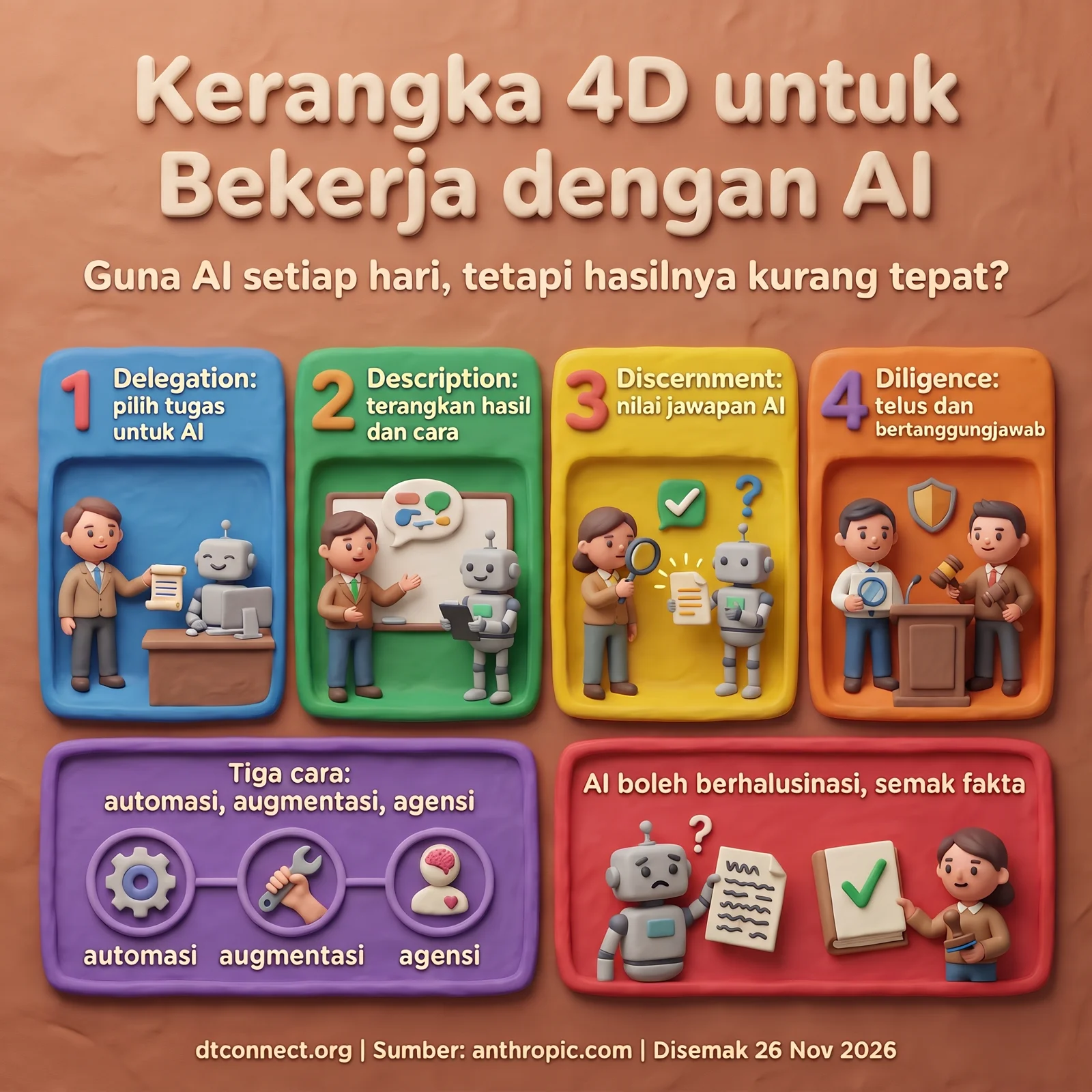
- Tiga cara bekerja dengan AI. Automation (automasi): AI melaksanakan tugas yang anda arahkan. Augmentation (augmentasi): AI menjadi rakan berfikir dan bekerja. Agency (agensi): AI dikonfigurasi untuk bekerja secara bebas bagi pihak anda.
- Kerangka 4D. Empat kemahiran teras: Delegation, Description, Discernment dan Diligence.
- Delegation. Tentukan tugas yang sesuai untuk AI. Ia merangkumi Problem Awareness (faham masalah anda), Platform Awareness (kenal alat AI yang ada) dan Task Delegation (agihkan tugas antara anda dan AI).
- Description. Terangkan dengan jelas apa yang anda mahu. Product Description ialah hasil yang mahu dihasilkan. Process Description ialah caranya. Performance Description ialah gaya dan standard kerjasama dengan AI.
- Discernment. Nilai hasil AI dan cara AI bertindak, melalui Product, Process dan Performance Discernment.
- Diligence. Bertanggungjawab semasa mencipta (Creation Diligence), telus tentang penggunaan AI (Transparency Diligence) dan bertanggungjawab apabila hasil digunakan (Deployment Diligence).
- Asas teknikal. Model bahasa belajar melalui pre-training (mengenal corak daripada sangat banyak contoh) dan fine-tuning (latihan tambahan untuk memperhalusi model).
- Had AI. Antaranya tarikh had pengetahuan, halusinasi (fakta yang salah), had context window (jumlah teks yang boleh diproses sekali gus) dan cabaran penaakulan kompleks.
Apa maksudnya untuk anda
Bagi guru, kerangka ini membantu anda berfikir sebelum menaip arahan. Contohnya, untuk menyediakan lembaran kerja, tanya diri dahulu: bahagian mana sesuai untuk AI, dan bahagian mana perlu sentuhan anda sendiri?
Bagi pensyarah dan pekerja pejabat, tiga cara bekerja ini memudahkan pilihan. Tugas rutin seperti menyusun nota mungkin sesuai untuk automasi. Merangka idea kertas kerja pula lebih sesuai dibuat bersama AI sebagai rakan berfikir.
Paling penting, anda tetap bertanggungjawab atas hasil akhir. AI boleh tersilap, jadi jawapannya perlu dinilai, bukan terus diterima.
Cara mula mengamalkan
- Pilih satu tugas minggu ini dan tentukan sama ada ia sesuai untuk automasi, augmentasi atau agensi.
- Sebelum menulis arahan, terangkan tiga perkara kepada AI: hasil yang anda mahu, cara kerja yang dikehendaki dan standard kualiti.
- Baca jawapan AI dengan teliti. Semak fakta, angka dan nama, kerana AI boleh berhalusinasi.
- Maklumkan secara telus apabila anda menggunakan AI dalam kerja yang dikongsi.
- Sebelum menggunakan hasil itu, tanya diri: adakah saya sanggup bertanggungjawab atas kandungan ini?
Perkara yang perlu diberi perhatian
Jangan masukkan data peribadi murid, pelajar atau pelanggan ke dalam alat AI. Ingat juga bahawa AI ada tarikh had pengetahuan, jadi maklumat terkini mungkin tiada atau sudah lapuk. Kerangka 4D ialah cara berfikir, bukan peraturan rasmi di tempat kerja anda. Ikut juga garis panduan institusi masing-masing. Ini ringkasan oleh Dimensi, bukan bahan rasmi Anthropic.
Kesimpulan
AI Fluency: Framework and Foundations memberi asas yang kukuh untuk sesiapa yang mahu bekerja dengan AI secara cekap, beretika dan selamat. Ingat tiga cara bekerja dan empat D: pilih tugas, terangkan dengan jelas, nilai jawapan, dan kekal telus serta bertanggungjawab. Ikuti episod seterusnya dalam Siri Sijil AI Pendidik melalui hab siri di bawah.
Sumber
- Anthropic. AI Fluency: Framework and Foundations (Skilljar). anthropic.skilljar.com
- Anthropic. AI Fluency. anthropic.com/ai-fluency
- Anthropic. AI Fluency: Overview. anthropic.com/ai-fluency/overview
- Coursera. AI Fluency: Framework and Foundations. coursera.org
Ringkasan ini ditulis oleh Dimensi berdasarkan pengalaman penulis menamatkan kursus ini dan semakan laman rasmi. Ia bukan bahan rasmi penyedia kursus. Artikel ini bebas dan tidak ditaja.
Ikuti siri ini: Siri Sijil AI Pendidik: Semua Episod
Read this article in English
Do you use AI (artificial intelligence, software that can generate text, answer questions or make suggestions) almost every day, but sometimes the results are not quite right? Many people copy AI answers straight away without checking them. Others give a one-line instruction, then feel disappointed with the result.
The problem is often not the tool, but the way we work with it. Teachers, lecturers and office workers need to know when AI should be used, how to give clear instructions and how to evaluate its answers.
This is the first episode of Siri Sijil AI Pendidik, a new ten-episode series. In this series, Dimensi summarises AI courses completed by Dr. Muhamad Hariz, the writer of Dimensi. We begin with the course AI Fluency: Framework and Foundations from Anthropic.
About this course
The course was developed by Prof. Rick Dakan (Ringling College of Art and Design) and Prof. Joseph Feller (University College Cork) together with Anthropic. The course materials are licensed under CC BY-NC-SA 4.0 (an open licence that allows sharing for non-commercial purposes).
The format consists of videos, reflection questions, exercises with a language model (an AI system that understands and generates text) and downloadable materials. Anthropic’s site says the course activities do not require a paid subscription. Coursera states that all features of this course are free. The Skilljar platform offers a course completion certificate after a final assessment. The number of lessons and study time differ by platform, so check the site you choose.
Key points
- Three ways of working with AI. Automation: AI carries out tasks you instruct. Augmentation: AI acts as a thinking and working partner. Agency: AI is configured to work independently on your behalf.
- The 4D Framework. Four core competencies: Delegation, Description, Discernment and Diligence.
- Delegation. Decide which tasks suit AI. It covers Problem Awareness (understand your problem), Platform Awareness (know the AI tools available) and Task Delegation (divide the work between you and AI).
- Description. Explain clearly what you want. Product Description is the output you want produced. Process Description is how. Performance Description is the style and standard of collaboration with AI.
- Discernment. Evaluate AI output and how AI behaves, through Product, Process and Performance Discernment.
- Diligence. Be responsible while creating (Creation Diligence), be transparent about AI use (Transparency Diligence) and be responsible when the output is used (Deployment Diligence).
- Technical basics. Language models learn through pre-training (recognising patterns from a very large number of examples) and fine-tuning (additional training to refine the model).
- AI limitations. These include a knowledge cutoff date, hallucination (incorrect facts), context window limits (the amount of text that can be processed at once) and challenges with complex reasoning.
What it means for you
For teachers, this framework helps you think before typing an instruction. For example, when preparing a worksheet, first ask yourself: which parts suit AI, and which parts need your own touch?
For lecturers and office workers, the three ways of working make choices easier. Routine tasks such as organising notes may suit automation. Drafting ideas for a paper is better done with AI as a thinking partner.
Most importantly, you remain responsible for the final result. AI can make mistakes, so its answers need to be evaluated, not simply accepted.
How to start putting it into practice
- Pick one task this week and decide whether it suits automation, augmentation or agency.
- Before writing an instruction, describe three things to the AI: the output you want, the process to follow and the quality standard.
- Read the AI’s answer carefully. Check facts, figures and names, because AI can hallucinate.
- Be transparent when you use AI in shared work.
- Before using the output, ask yourself: am I willing to take responsibility for this content?
Things to watch out for
Do not enter personal data of pupils, students or clients into AI tools. Remember too that AI has a knowledge cutoff date, so recent information may be missing or outdated. The 4D Framework is a way of thinking, not an official rule at your workplace. Follow your own institution’s guidelines as well. This is a summary by Dimensi, not official Anthropic material.
Conclusion
AI Fluency: Framework and Foundations gives a solid foundation for anyone who wants to work with AI effectively, ethically and safely. Remember the three ways of working and the four Ds: choose the task, describe clearly, evaluate the answer, and stay transparent and responsible. Follow the next episode of Siri Sijil AI Pendidik through the series hub below.
Sources
- Anthropic. AI Fluency: Framework and Foundations (Skilljar). anthropic.skilljar.com
- Anthropic. AI Fluency. anthropic.com/ai-fluency
- Anthropic. AI Fluency: Overview. anthropic.com/ai-fluency/overview
- Coursera. AI Fluency: Framework and Foundations. coursera.org
This summary was written by Dimensi based on the writer’s experience of completing this course and a review of the official sites. It is not official material from the course provider. This article is independent and not sponsored.
Follow this series: Siri Sijil AI Pendidik: All Episodes